Contents:
- Why Basket Flower Arrangements Deserve More Respect
- The Basics: What Every Beginner Needs to Know
- Choosing the Right Basket
- Waterproofing and Mechanics
- Selecting Your Flowers
- Color Theory in a Basket Context
- Intermediate Level: Elevating Your Basket Arrangements
- Working with Texture and Form
- Establishing a Focal Point and Sight Lines
- Height and Proportion Rules
- Creating Natural Flow and Asymmetry
- Seasonal Flower Selection
- Advanced Nuances: What Separates Good from Exceptional
- The Grid Technique for Complex Arrangements
- Integrating Non-Floral Elements
- Fragrance Architecture
- Longevity Engineering
- Scaling for Different Sizes and Budgets
- Regional Differences in Basket Flower Arrangement Preferences
- Northeast Style
- Southern Style
- West Coast Style
- Common Mistakes to Avoid
- Overcrowding the Center
- Using All the Same Stem Length
- Neglecting the Back
- Dry Floral Foam
- Wrong Basket Proportions for the Occasion
- Ignoring Delivery Conditions
- Skipping the Water Check After Delivery
- How to Choose the Right Florist for Basket Flower Delivery
- Portfolio and Photography
- Freshness Guarantees
- Local vs. Wire Service
- Seasonal and Custom Options
- What to Expect When Ordering Basket Flower Delivery
- Pairing a Flower Basket with Complementary Gifts
- Basket Arrangements for Specific Occasions
- Get-Well Arrangements
- New Baby Arrangements
- Sympathy and Condolence Baskets
- Birthday and Celebration Baskets
- Corporate and Event Arrangements
- Frequently Asked Questions
- How long does a basket flower arrangement typically last?
- What’s the difference between a flower basket and a bouquet?
- Can I request specific flowers for a basket delivery, or do I have to accept whatever the florist chooses?
- Is basket flower delivery available same-day in most areas?
Here’s a myth that gets repeated constantly in floral design circles: basket arrangements are the “easy” option — a beginner’s shortcut that serious florists grow out of. The assumption is that tossing blooms into a wicker basket requires no real skill, and that anyone who orders a basket of flowers delivery is settling for something lesser than a formal vase bouquet.
That couldn’t be more wrong. Basket flower arrangements are one of the most technically demanding forms in floristry — and when done right, they’re also among the most breathtaking. The difference between a grocery-store grab-and-go basket and a professionally designed arrangement is enormous. This guide will walk you through that entire spectrum, from the foundational principles beginners need to master, to the nuanced decisions that separate competent arrangers from true artists.
Whether you’re planning to create something yourself, shopping for a gift, or simply trying to understand what makes one arrangement worth $45 and another worth $180, you’ll leave here with a completely different perspective on the humble flower basket.
Why Basket Flower Arrangements Deserve More Respect
The first thing to understand is that baskets introduce a structural challenge that vases actually solve for you. A vase’s narrow neck holds stems in place and keeps them upright. Take that neck away, and suddenly you have to engineer that support yourself. Every stem needs to be anchored, angled, and balanced in three-dimensional space — and it all has to look effortless.
Beyond technique, basket arrangements carry a warmth and informality that makes them uniquely suited to certain emotional moments. They feel generous, abundant, and personal in a way that a formal centerpiece bouquet rarely achieves. They’re the arrangement people photograph and post on social media. They’re what shows up in a hospital room and makes the patient genuinely smile. They’re what a host sets on a dining table when they want the room to feel welcoming rather than formal.
The design possibilities are also considerably broader than with vases. Baskets come in dozens of shapes, materials, and sizes. They can be low and wide for a spreading garden aesthetic, tall and narrow for an elegant vertical display, rustic and unpolished for a farmhouse feel, or lacquered and refined for a modern event. That range of vessel options multiplies the creative potential of every arrangement inside it.
Florists at Flowers Central Jersey have long recognized this, building out an extensive basket collection precisely because clients in central New Jersey respond to arrangements that feel lush and personal — not stiff or overly formal. The regional preference is real, and we’ll come back to regional differences in detail later in this guide.
The Basics: What Every Beginner Needs to Know
Choosing the Right Basket
This is where more beginners go wrong than at any other step. The basket isn’t a neutral backdrop — it’s an active design element that sets the tone for everything that goes into it. A few critical considerations:
- Size relative to the intended display location: A basket that looks balanced on a dining table will look lost on a fireplace mantle. Measure your space before you shop.
- Material and texture: Natural wicker reads as warm and organic. Painted or lacquered baskets feel more polished. Metal wire baskets bring an industrial edge. Each signals a different design intention.
- Handle or no handle: Handles add height and visual interest but can complicate how you position taller stems. Handleless baskets give you more freedom but less architectural drama.
- Color coordination: A medium-toned natural wicker is the safest universal base. Very dark baskets can absorb visual attention; very light ones can clash with pale blooms. When in doubt, stay neutral.
For beginners, a round or oval wicker basket in the 10–14 inch diameter range is ideal. It’s large enough to create genuine impact but manageable enough to control.
Waterproofing and Mechanics
Because baskets aren’t waterproof, you need to create a moisture barrier before you introduce any fresh flowers. Options include:
- A plastic liner designed for floral use, which sits inside the basket and holds water or floral foam
- A waterproof foil sheet wrapped tightly around a foam block before placing it in the basket
- A separate waterproof container (a small pot or bowl) that fits inside the basket opening
Floral foam — also called Oasis foam — is the most common mechanics choice for basket arrangements. It holds stems at precise angles, retains water to keep blooms fresh, and can be cut to fit any shape. Soak it thoroughly before use (let it sink naturally in water rather than pressing it down — forcing it creates dry pockets inside). The foam should sit slightly above the rim of the basket so you can angle stems downward at the edges, creating that characteristic cascading fullness.
Selecting Your Flowers
A well-structured basket arrangement typically uses three categories of flowers:
- Focal flowers: The stars of the arrangement. These are your largest, most visually prominent blooms — roses, peonies, sunflowers, or lilies. They establish color story and draw the eye.
- Secondary flowers: Mid-sized blooms that surround and support the focal flowers — spray roses, alstroemeria, or lisianthus. They add volume and complexity without competing for attention.
- Filler flowers and greenery: The finishing layer that ties everything together and covers mechanics — baby’s breath, wax flower, eucalyptus, fern, or Italian ruscus. These give the arrangement a full, finished look.
For a basic beginner basket, a ratio of roughly 30% focal, 40% secondary, and 30% filler is a reliable starting point. As your skill grows, you’ll begin to break those proportions deliberately for specific effects.
Color Theory in a Basket Context
Three color schemes work reliably well for basket arrangements:
- Monochromatic: Multiple shades and tones within a single hue. A white-cream-ivory basket feels serene and elegant; a deep red-burgundy-blush basket reads as passionate and romantic.
- Analogous: Colors adjacent on the color wheel — pink, peach, and coral together, or purple, lavender, and blue. These combinations feel harmonious and easy on the eye.
- Complementary: Colors opposite on the wheel — purple with yellow, or orange with blue. Bold, high-energy combinations that photograph strikingly.
Avoid using more than three distinct hues in a beginner arrangement. More than that, and the basket starts to look chaotic rather than abundant.
Intermediate Level: Elevating Your Basket Arrangements
Working with Texture and Form
Once you’ve mastered basic color and mechanics, the next level is about variety in texture and bloom form. A basket filled entirely with round-headed roses is pleasant but flat. Introduce some spiky forms (like snapdragons or gladiolus), some star-shaped blooms (like alstroemeria), some clustered forms (like hydrangea), and the arrangement immediately gains visual depth and sophistication.
Textural contrast in greenery matters just as much as in the blooms themselves. Smooth eucalyptus leaves paired with feathery fern creates a layered, dimensional backdrop that makes every flower in front of it stand out more sharply.
Establishing a Focal Point and Sight Lines
Every arrangement needs a visual anchor — a point where the eye naturally lands first. In a basket arrangement, this is typically placed slightly above and just behind the geometric center of the foam block, creating a peak that draws attention while allowing the surrounding flowers to radiate outward.
Think about sight lines: where will this arrangement be viewed from? A centerpiece basket placed on a dining table needs to look good from all sides. An arrangement sitting against a wall on a console table only needs a strong front face. Building for the correct viewing angle prevents the common mistake of having a beautiful front and a messy or sparse back.
Height and Proportion Rules
The classic proportional rule in floral design is that the tallest element in an arrangement should be 1.5 to 2 times the height of the container. For basket arrangements, measure from the base of the basket to the top of the handle (or the rim if there’s no handle). Your tallest stem should extend 1.5 to 2 times that measurement above the base.
This creates visual balance — the arrangement looks appropriately substantial without toppling the eye upward or squashing down too flat. Breaking this rule intentionally can create dramatic effects, but you have to understand the rule before you can break it with purpose.
Creating Natural Flow and Asymmetry
Perfectly symmetrical basket arrangements look artificial and stiff. Nature isn’t symmetrical, and the best basket arrangements mimic nature’s own logic — clusters of color appearing in organic groupings, stems flowing in slightly different directions, greenery spilling unevenly over one side of the basket’s edge.
A practical technique: place your flowers in odd-numbered groupings (3, 5, 7 of the same bloom) rather than even numbers. Odd groupings feel natural; even groupings feel arranged. Place these clusters at slightly different heights and angles. Step back frequently and view the arrangement from multiple angles as you work.
Seasonal Flower Selection
Basket arrangements that use in-season flowers are both more beautiful and more affordable. In 2026, a professionally designed spring basket featuring tulips, ranunculus, and anemones typically runs $65–$95 for a medium arrangement. A comparable arrangement using out-of-season exotics can reach $140–$175 for the same visual effect, because the cost of sourcing those blooms is significantly higher.
Seasonal guidelines for basket arrangements:
- Spring (March–May): Tulips, peonies, ranunculus, hyacinth, daffodils, anemones
- Summer (June–August): Sunflowers, zinnias, dahlias, garden roses, lisianthus, lavender
- Fall (September–November): Dahlias, marigolds, mums, hypericum berries, wheat, warm-toned roses
- Winter (December–February): Amaryllis, paperwhites, poinsettias, pine, holly, white roses
If roses are part of your basket vision regardless of season, the good news is that quality roses are available year-round from top florists. You can shop roses here to see the current selection, which varies with availability and season.
Advanced Nuances: What Separates Good from Exceptional
The Grid Technique for Complex Arrangements
For advanced basket arrangements — particularly wider, lower baskets meant to cascade — the grid technique offers precise control over stem placement. Instead of relying entirely on floral foam, tape a grid of clear waterproof tape across the opening of your lined basket before inserting any foam. This grid acts as a secondary support structure, allowing you to position stems at sharp horizontal angles without them slipping or rotating after placement.
The grid also lets you work without foam if you prefer a more natural stem arrangement, though foam remains the more water-retentive and longer-lasting option for most cut flowers.
Integrating Non-Floral Elements
Expert basket arrangements frequently incorporate non-floral elements to add character, texture, and personal meaning:
- Fruits and vegetables: Lemons, artichokes, and trailing grape clusters turn a floral basket into an abundant harvest-style display
- Succulents: Their structural geometry contrasts beautifully with soft blooms and they extend the lifespan of the arrangement after cut flowers fade
- Branches and botanicals: Budding branches, air plants, or seed pods add architectural interest
- Ribbon and accents: A single well-tied ribbon in a complementary color adds finished polish to a gift basket; more than one ribbon tends to look cluttered
Fragrance Architecture
Top florists think about how a basket arrangement smells, not just how it looks. Fragrance has a powerful emotional impact — it’s the sense most directly tied to memory and emotion. Pairing intensely fragrant flowers (like garden roses, hyacinth, or sweet peas) with more neutral blooms creates a balanced olfactory experience rather than an overwhelming one.
A professional trick: keep highly fragrant flowers toward the back or center of the arrangement. As warm air rises, the fragrance disperses forward and outward toward the viewer, creating a gentle scent trail rather than a direct assault.
Longevity Engineering
A basket arrangement that looks stunning on delivery day but wilts within 48 hours is a disappointment. Here’s how skilled florists extend vase life in basket arrangements:
- Use flower food in the water that hydrates the foam — the carbohydrates and biocides significantly extend bloom life
- Rehydrate the foam every day by pouring water slowly over it rather than submerging the whole basket
- Keep the arrangement away from heating vents, direct sunlight, and ripening fruit (ethylene gas from fruit accelerates flower aging)
- Remove any single bloom that’s visibly dying before it accelerates the decline of neighboring flowers
- Mist the arrangement lightly with water once a day — this is especially helpful for flowers like hydrangea, which can absorb water through their petals
With proper care, a quality basket arrangement from a professional florist should look excellent for 5–7 days and remain presentable for up to 10 days.
Scaling for Different Sizes and Budgets
One of the most practical advanced skills is learning to scale a design concept across different size points without losing design integrity. Here’s a rough guide to what’s achievable at different investment levels in 2026:
- $45–$65: A small to medium basket (8–10 inches) with 3–5 focal flowers, secondary blooms, and full greenery. Ideal for hospital visits, thinking-of-you gestures, or thank-you gifts.
- $75–$110: A medium basket (10–14 inches) with 6–10 focal flowers, layered textures, and seasonal specialty blooms. Strong enough for birthday or anniversary delivery.
- $120–$175: A large, full basket (14–20 inches) with premium blooms, significant volume, and custom design elements. Appropriate for major celebrations, baby showers, sympathy arrangements, or impressive event displays.
- $200+: Grand-scale arrangements for weddings, corporate events, or elaborate gift presentations. Often include specialty flowers, fruits, or hardscape elements.
Regional Differences in Basket Flower Arrangement Preferences
One aspect of basket floral design that rarely gets discussed is how dramatically regional preferences shape what people consider beautiful. A florist designing for clients in Charleston, South Carolina is working with a completely different aesthetic expectation than one serving customers in Portland, Oregon or New York City. Understanding these regional tastes is particularly relevant for anyone shopping for basket delivery to a specific location.
Northeast Style
In the Northeast — particularly in states like New Jersey, New York, Connecticut, and Massachusetts — basket arrangements tend toward classic elegance. Think tightly packed blooms in sophisticated color palettes: deep burgundy and cream, soft blush and white, rich jewel tones. Garden roses, hydrangea, and orchids feature prominently. The baskets themselves tend to be refined — clean lines, often with a lacquered or painted finish rather than raw wicker.
There’s also a strong appreciation in the Northeast for longevity and value. Clients here scrutinize quality and expect arrangements to hold up well for a full week. Premium flowers and careful conditioning of stems are non-negotiable in this market.
Because New Jersey specifically sits at the intersection of suburban sophistication and genuine community warmth, florists here often balance formal elegance with a personal, generous feel. A central New Jersey basket arrangement is typically fuller and more abundant than a comparable Manhattan arrangement, which might lean toward minimalist and architectural.
Southern Style
Across the South — from Virginia down through Georgia and the Gulf States — basket flower arrangements embrace lushness, warmth, and a certain romanticism that reflects the region’s cultural character. Pastel palettes reign: soft peach, blush, lavender, and pale yellow dominate. Garden roses, magnolia blooms, sweet peas, and wildflower-style filler flowers like Queen Anne’s lace and chamomile are particularly favored.
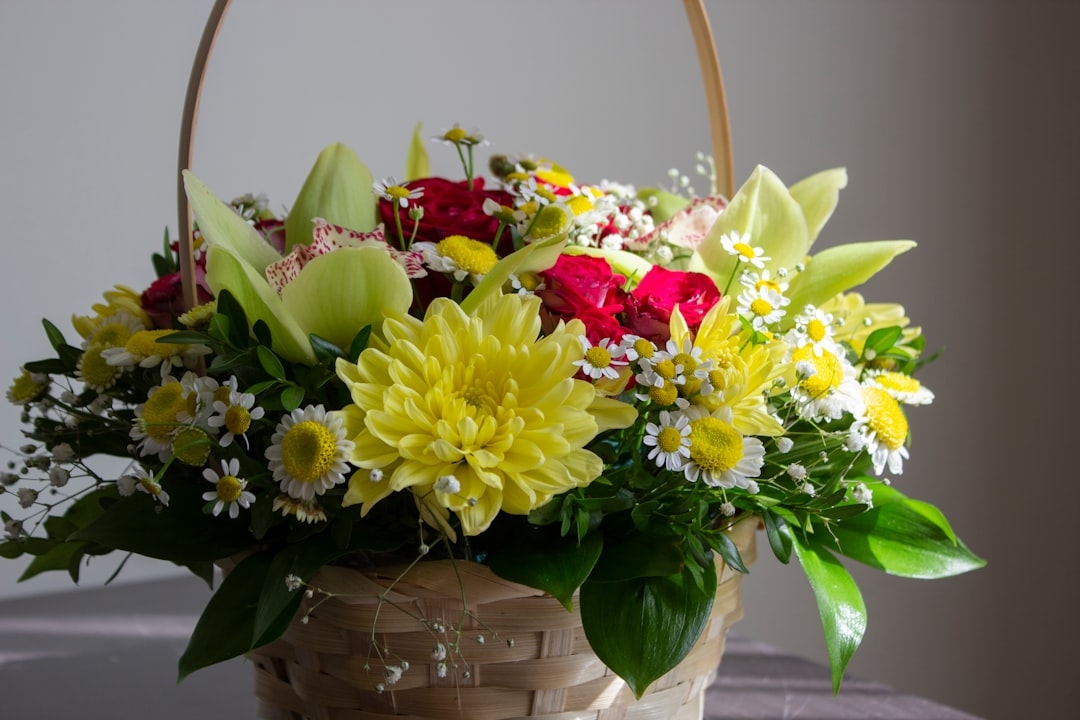
Southern basket arrangements tend to be deliberately informal — the “overflowing cottage garden” aesthetic is extremely popular. Wicker textures are embraced enthusiastically, and arrangements often cascade generously over basket edges. Fragrance is especially valued in Southern markets; clients there are more likely to specify scented varieties and ask for aromatic greenery like rosemary or mint alongside traditional filler.
Events and occasions drive a huge portion of Southern basket orders — porch parties, church events, baby showers, and debutante celebrations all call for large, abundant, personalized arrangements. The cultural expectation around these occasions is for generosity; an arrangement that looks “just enough” reads as underwhelming.
West Coast Style
The West Coast — California, Oregon, and Washington — has developed a distinct aesthetic that’s increasingly influential nationally. It’s been called “organic modernism”: clean lines and intentional design borrowed from minimalist traditions, combined with natural textures, wild-looking botanical elements, and a deliberate embrace of imperfection.
Popular choices in West Coast basket arrangements include proteas, anemones, dahlias, pampas grass, dried elements, and unusual greenery like monstera leaves or eucalyptus varieties that aren’t as common elsewhere. Color palettes are often earthy and muted — terracotta, dusty sage, warm cream, dried-flower taupes — rather than the bright, saturated colors that play well in other regions.
Sustainability is a significant purchasing factor on the West Coast. Clients there are more likely to ask about flower sourcing, prefer locally grown or domestic blooms over imported ones, and choose biodegradable basket materials over plastic-lined options. A West Coast florist who can speak knowledgeably about sustainable practices has a genuine competitive advantage.
Common Mistakes to Avoid
These are the errors that consistently separate disappointing basket arrangements from genuinely impressive ones. Some are practical; some are conceptual. All of them are avoidable.
Overcrowding the Center
The instinct when filling a basket is to pile flowers into the center and call it done. The result is an arrangement that’s dense in the middle and thin at the edges, looking more like a bouquet dropped into a basket than an actual arrangement. Always work from the perimeter inward, placing your greenery and filler at the outer edges first, then building inward and upward toward your focal flowers. This creates even distribution and that characteristic rounded fullness.
Using All the Same Stem Length
When every stem is cut to the same length, the arrangement loses dimension and looks flat from the side. Vary your stem lengths intentionally: taller focal flowers in the center and back, secondary flowers slightly shorter surrounding them, filler and spilling elements at the lowest level near the basket edge. Aim for at least three distinct height levels in any arrangement larger than 10 inches.
Neglecting the Back
If the basket will be seen from multiple angles, the back matters as much as the front. Beginners typically design only what they can see directly in front of them, then rotate the basket and discover a sparse, unfinished reverse side. Work in the round for any arrangement that will be displayed away from walls.
Dry Floral Foam
Floral foam that wasn’t fully saturated before use has dry pockets that flowers can’t access, leading to premature wilting even when the foam surface feels damp. Always let foam sink into water on its own — it takes about 60–90 seconds — rather than pressing it down. Press-saturated foam has air trapped in the core that will eventually dry out your flowers from the inside.
Wrong Basket Proportions for the Occasion
A tiny basket sent as a sympathy arrangement looks insignificant and potentially dismissive. An enormous elaborate basket sent as a casual birthday gift can feel overwhelming or showy rather than warm. Match the scale of the arrangement to the emotional register of the occasion. Thinking-of-you and get-well arrangements should feel generous but not extravagant; milestone celebrations can go large.
Ignoring Delivery Conditions
If you’re ordering a basket of flowers for delivery — particularly in summer — consider how the arrangement will survive the journey. A skilled florist conditions flowers before placing them, uses water-saturated foam, and secures stems so the arrangement doesn’t shift in transit. When ordering from an online florist, check whether they use local delivery partners and whether their arrangements are designed for transport stability. A beautiful basket that arrives with toppled stems and loose blooms has already failed at its most basic job.
Skipping the Water Check After Delivery
Many recipients assume a delivered arrangement is fully set and forget about it. In reality, a basket arrangement’s foam begins drying out within 12–24 hours depending on temperature and bloom types. Always check the foam moisture the day after delivery and add water as needed. This single habit extends the arrangement’s lifespan by 2–3 days.
How to Choose the Right Florist for Basket Flower Delivery
Not all florists approach basket arrangements with equal skill or investment. When evaluating a florist for delivery, there are a few reliable indicators of quality:
Portfolio and Photography
A florist confident in their basket arrangements will show them prominently. Look for real photography of actual delivered arrangements rather than stock images. Stock photos tell you nothing about what you’ll actually receive; original photography of real work tells you everything.
Freshness Guarantees
Quality florists stand behind their product. Look for explicit freshness guarantees — language that commits to replacing or crediting arrangements that arrive in poor condition. This is a signal that the florist controls their supply chain and has confidence in their sourcing and conditioning practices.
Local vs. Wire Service
There’s an important distinction between a true local florist and a national wire service that takes your order and farms it out to a local shop of unknown quality. True local florists design and fulfill arrangements in-house, giving them complete control over quality. Wire services often send a percentage of your order cost to the fulfilling florist, which means what arrives may be significantly less impressive than what was advertised online.
Seasonal and Custom Options
A florist worth using for basket delivery should offer seasonal options and some degree of customization. The ability to specify color palette, basket style, or occasion type signals that the florist is actually designing arrangements rather than assembling from preset templates.
What to Expect When Ordering Basket Flower Delivery
If you’re ordering a basket of flowers for the first time, here’s a realistic picture of the process from selection to delivery:
Ordering: Most reputable florists allow 24–48 hours notice for standard orders. Same-day delivery is often available for orders placed before noon, though availability depends on the florist and your delivery area. For premium or custom arrangements, giving 48–72 hours notice produces noticeably better results — florists can source specific flowers rather than working with whatever’s on hand.
Customization options: Expect to be able to specify color preference, occasion, and any bloom dislikes or allergies (some recipients are sensitive to strongly fragrant flowers like lilies). Premium florists may offer specific basket style choices.
Delivery logistics: Professional florists use delivery vehicles and trained drivers who understand how to transport arrangements safely. Ask whether the florist uses in-house delivery or third-party courier services — in-house typically means more care in handling.
Pricing transparency: Reputable florists show clear pricing with size options. Be wary of florists who display attractive low prices prominently but bury upgrade and delivery fees. The total cost — flowers, delivery, and any add-ons — should be clear before checkout.
Substitution policies: Florists occasionally need to substitute specific flowers when inventory is unavailable. A quality florist’s substitution policy ensures they’ll maintain the overall color palette and design intent, not simply swap in cheaper filler flowers to meet the order value.
Pairing a Flower Basket with Complementary Gifts
A flower basket is already a complete gift, but pairing it thoughtfully can elevate the gesture significantly. Some combinations that work particularly well:
- With a candle: A soy or beeswax candle in a scent that complements the flowers creates a sensory experience rather than just a visual one. Cedar and vanilla pair well with warm-toned roses; citrus scents complement white and green arrangements.
- With artisanal chocolates or honey: These feel generous without being excessive. Local honey in particular has become a popular add-on that signals thoughtfulness.
- With a handwritten card: In an era of instant digital communication, a handwritten note carries genuine emotional weight. This is especially true for sympathy and appreciation gestures.
- With a small plant or succulent: Tucked into one corner of the basket or sent alongside, a small plant extends the “green life” of the gift long after the cut flowers fade.
Avoid pairing flower baskets with items that compete for visual attention — a large stuffed animal or prominent balloon next to a carefully designed basket undermines the arrangement’s visual impact. Let the flowers lead.
Basket Arrangements for Specific Occasions
Get-Well Arrangements
Hospital and home recovery settings call for arrangements that are cheerful but not overwhelming. Bright colors — yellow, orange, and warm pink — are associated with energy and optimism, making them excellent for get-well baskets. Keep arrangements moderate in size (8–12 inches is ideal for a bedside table or hospital windowsill) and avoid highly fragrant flowers like lilies, which some patients — particularly those undergoing chemotherapy or recovering from respiratory issues — find nauseating.
New Baby Arrangements
Soft, pastel palettes with delicate blooms like spray roses, sweet peas, and ranunculus work beautifully for new baby baskets. White and pale green combinations are gender-neutral and feel fresh and clean. Consider adding baby’s breath not as filler (its retro connotation can feel dated) but as a deliberate fluffy cloud element that reads as whimsical rather than fussy.
Sympathy and Condolence Baskets
Sympathy basket arrangements deserve particular care. White, cream, soft lavender, and pale green palettes signal comfort and peace. The scale should be substantial enough to feel meaningful — this is not the occasion for a small gesture — but the design should be calm rather than exuberant. Lush white hydrangea, white garden roses, and soft greenery in a natural wicker basket is a combination that reads as genuinely thoughtful across most cultures and backgrounds.
Birthday and Celebration Baskets
This is where you have the most design latitude. Vibrant colors, bold contrasts, and generous scale all signal celebration. Sunflowers and bright dahlias in a summer basket, or jewel-toned roses with deep burgundy anemones in a fall arrangement — these feel festive and memorable. Don’t be afraid of color here: this is the occasion for impact.
Corporate and Event Arrangements
Corporate basket arrangements need to read as professional rather than personal. Sophisticated palettes — white and green, blush and ivory, deep plum and soft grey — convey refined taste without veering into territory that might feel too romantic or casual for a professional context. Scale to the display location: reception desks and conference tables need large, architecturally confident arrangements; individual desk deliveries should be smaller and more contained.
Frequently Asked Questions
How long does a basket flower arrangement typically last?
With proper care — daily foam rehydration, keeping the arrangement away from heat and direct sunlight, and removing any dying blooms promptly — a professionally designed basket arrangement should look excellent for 5–7 days and remain presentable for up to 10 days. The longevity varies significantly by flower type: roses and chrysanthemums typically outlast lilies and hydrangea in a basket setting.
What’s the difference between a flower basket and a bouquet?
A bouquet is a grouping of stems tied or wrapped together, designed to be placed in a vase by the recipient. A basket arrangement is a self-contained design — the flowers are already arranged and anchored in floral foam inside a basket, ready for display the moment it’s delivered. Basket arrangements require no additional work from the recipient and are often considered more impressive as gifts because they arrive fully realized and immediately beautiful.
Can I request specific flowers for a basket delivery, or do I have to accept whatever the florist chooses?
Most professional florists welcome color and bloom preferences. You can typically specify a general color palette, request or exclude specific flowers, and note the occasion to guide the design. For very specific requests — a particular variety of rose, a specific seasonal bloom — it’s worth calling the florist directly rather than ordering online, as availability can vary. Premium florists may charge slightly more for highly specific custom requests depending on sourcing requirements.
Is basket flower delivery available same-day in most areas?
Many local florists offer same-day delivery for orders placed before noon or 1 PM in their local time zone. Availability depends on the florist’s delivery area, current order volume, and the complexity of the arrangement requested. Standard basket arrangements are more likely to be available same-day than elaborate custom designs. If you’re ordering for a specific time-sensitive occasion, calling the florist directly to confirm same-day availability is always the safest approach.